EveryEvent SF

Alle Events durchsuchen

Find every event in San Francisco

events

Concerts & Live Music
Festivals
Sports & Recreation
Food & Drink
Arts & Culture
Community
Family & Kids
Nightlife
Comedy
Theater
Beliebte Reiseziele
BaliSedonaLos AngelesCosta RicaNew YorkSan FranciscoAustinMiamiJoshua TreeTulum
Alle Kategorien anzeigenAlle Reiseziele anzeigen

Alle Funktionen entdecken

Leistungsstarke Tools für Ihre Veranstaltungen

Plattform-Funktionen

Intelligente dynamische Preisgestaltung
Ticket-Kategorien
Sitzplatzreservierung
Warenkorbabbruch-Wiederherstellung
Besucher-Wiedergewinnung
Spenden & Staffelpreise
Affiliate-System
Ticket-Scanner
Rabattcodes
Individuelle Fragen
Ticket-Teilen
Upsells & Add-ons
Analysen & Berichte
E-Mail-Sequenzen
Warteliste / Benachrichtigen / Erinnern
Entdecken
Discovery HubArtists & PerformersVenuesKnowledge Base
Alle Funktionen anzeigenÜber uns
PreiseBlog
Alle Veranstaltungen durchsuchen

events

Concerts & Live MusicFestivalsSports & RecreationFood & DrinkArts & CultureCommunityFamily & KidsNightlife

Beliebte Reiseziele

BaliSedonaLos AngelesCosta RicaNew YorkSan Francisco

Entdecken

Discovery HubArtists & PerformersVenuesKnowledge Base

Plattform-Funktionen

Intelligente dynamische PreisgestaltungTicket-KategorienSitzplatzreservierungWarenkorbabbruch-WiederherstellungBesucher-WiedergewinnungSpenden & StaffelpreiseAffiliate-SystemTicket-ScannerRabattcodesIndividuelle FragenTicket-TeilenUpsells & Add-onsAnalysen & BerichteE-Mail-SequenzenWarteliste / Benachrichtigen / Erinnern
Alle Funktionen anzeigenÜber uns
PreiseBlog
AnmeldenRegistrierenVeranstalter
  • Browse All Events
  • Concerts & Live Music
  • Festivals
  • Sports & Recreation
  • Food & Drink
  • Arts & Culture
  • Community
  • Family & Kids
  • Nightlife
  • Alle Kategorien →
  • Napa Valley
  • Sonoma
  • Lake Tahoe
  • Carmel
  • Big Sur
  • All Destinations →
  • For Promoters
  • For Artists
  • For Venues
  • For Festivals
  • For Event Spaces
  • For Nonprofits
  • For Bloggers
  • For Speakers
  • Brand Ambassador
  • Case Studies
  • 350.000+ Käufernetzwerk
  • Warenkorbabbruch-Wiederherstellung
  • Intelligente dynamische Preisgestaltung
  • Ticket-Kategorien
  • Wiederkehrende Veranstaltungen
  • Sitzplatzreservierung
  • Affiliate-System
  • Warteliste / Benachrichtigen
  • Ticket-Scanner
  • Einbettungs-Widget
  • Event Syndication
  • Message Center
  • Integrations
  • Reports
  • Alle Funktionen →
  • Über uns
  • The Ecosystem
  • Blog
  • Glossar
  • Inspiration
  • Hilfe-Center
  • Kontakt
  • API-Dokumentation
  • Marken-Assets
  • Karriere
  • Presse
  • Nutzungsbedingungen
  • Datenschutzrichtlinie

Events

  • Browse All Events
  • Concerts & Live Music
  • Festivals
  • Sports & Recreation
  • Food & Drink
  • Arts & Culture
  • Community
  • Family & Kids
  • Nightlife
  • Alle Kategorien →

Getaways

  • Napa Valley
  • Sonoma
  • Lake Tahoe
  • Carmel
  • Big Sur
  • All Destinations →

For Organizers

  • For Promoters
  • For Artists
  • For Venues
  • For Festivals
  • For Event Spaces
  • For Nonprofits
  • For Bloggers
  • For Speakers
  • Brand Ambassador
  • Case Studies

Funktionen

  • 350.000+ Käufernetzwerk
  • Warenkorbabbruch-Wiederherstellung
  • Intelligente dynamische Preisgestaltung
  • Ticket-Kategorien
  • Wiederkehrende Veranstaltungen
  • Sitzplatzreservierung
  • Affiliate-System
  • Warteliste / Benachrichtigen
  • Ticket-Scanner
  • Einbettungs-Widget
  • Event Syndication
  • Message Center
  • Integrations
  • Reports
  • Alle Funktionen →

Unternehmen

  • Über uns
  • The Ecosystem
  • Blog
  • Glossar
  • Inspiration
  • Hilfe-Center
  • Kontakt
  • API-Dokumentation
  • Marken-Assets
  • Karriere
  • Presse
  • Nutzungsbedingungen
  • Datenschutzrichtlinie
EveryEvent
© 2026 EveryEvent San Francisco. Alle Rechte vorbehalten.
Featured

Indian Civilization's Unique Philosophicaland Spiritual Heritage

Dalai Lama
Dalai Lama
Jun 7, 2024
4 min read
Watch · 3

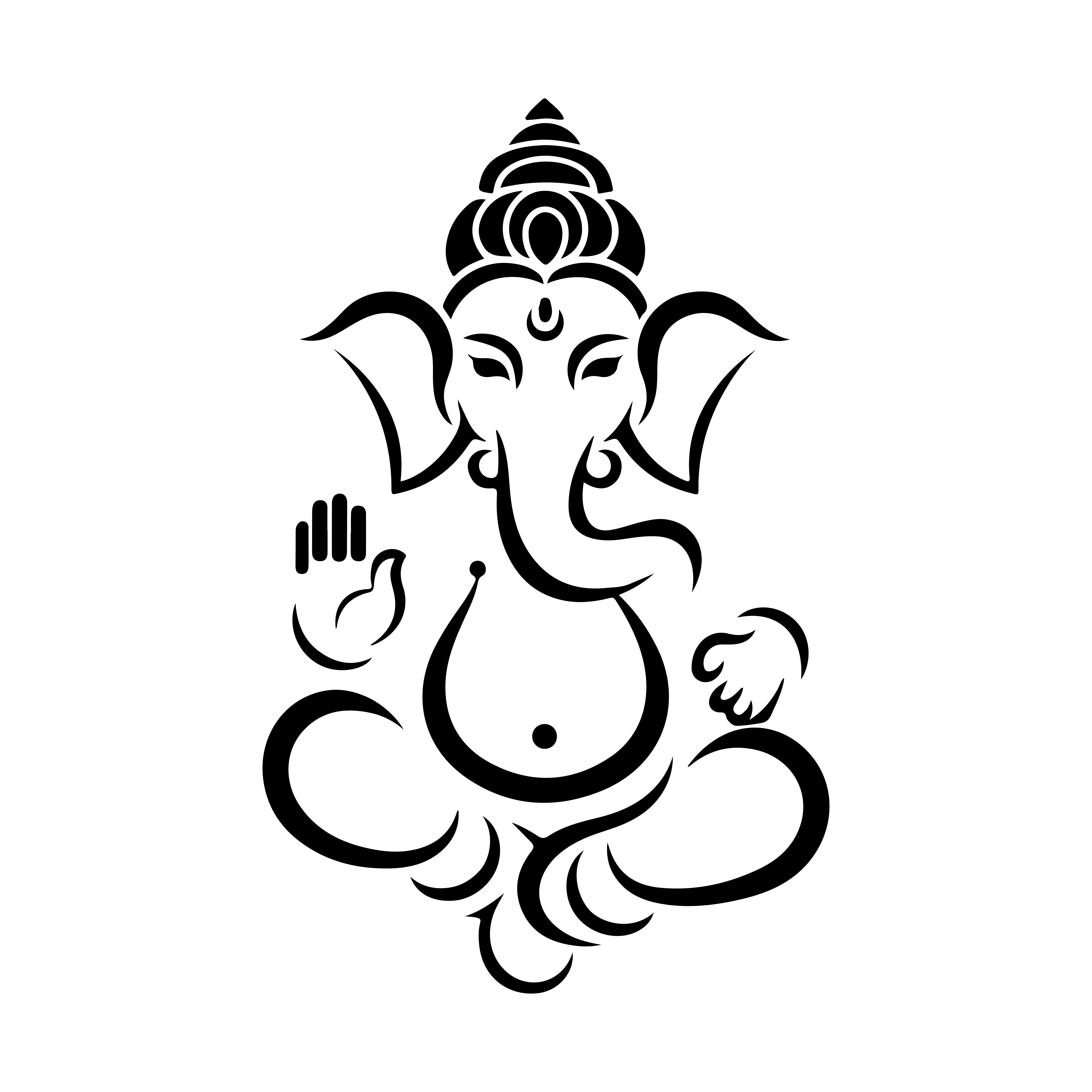
TLDR: In this brief reflection, the Dalai Lama addresses what distinguishes Indian civilization from other major world cultures. Rather than focusing on material or political power, he emphasizes the enduring spiritual and philosophical legacy that has shaped human consciousness across centuries. Indian civilization's commitment to investigating the nature of mind, suffering, and liberation—through multiple schools of thought and rigorous debate—represents a unique contribution to human understanding that transcends borders and remains relevant across different belief systems.

Read · 6 sections

What Makes Indian Civilization Stand Apart?

The Dalai Lama's observation centers on a fundamental difference in how Indian civilization approached knowledge and human development. Unlike civilizations that primarily consolidated power through conquest or built monuments to material greatness, Indian culture invested deeply in investigating subjective experience—the workings of the mind, the causes of suffering, and pathways to genuine well-being.

This emphasis on inner investigation created a unique intellectual ecosystem where multiple competing philosophies could coexist and engage in rigorous dialogue. Rather than a single dominant doctrine suppressing alternatives, Indian tradition fostered schools that debated foundational questions: What is the nature of consciousness? How do we know what is real? What are the causes of human suffering? These were not abstract academic exercises but practical investigations with direct application to how people lived.

Why Did Indian Thinkers Focus on the Mind?

Indian civilization developed what might be called a sophisticated "science of mind" long before modern psychology emerged in the West. The Buddhist, Hindu, and other philosophical traditions produced detailed taxonomies of mental states, mechanisms of attachment and aversion, and systematic methods for training attention and understanding perception.

This focus arose from a practical recognition: external conditions change, empires rise and fall, but the quality of one's inner experience remains the most immediate reality. Therefore, mastering the mind became understood as the highest pursuit. Whether through yoga, meditation, logic, or ethical cultivation, Indian traditions converged on the idea that lasting well-being comes from understanding and transforming one's own consciousness.

How Did Indian Philosophy Maintain Diversity?

Rather than enforcing doctrinal uniformity, Indian civilization created institutions—monasteries, debate halls, universities like Nalanda—where different schools could test their ideas against one another. A Buddhist philosopher might spend years engaging with Vedantic thinkers, each sharpening their arguments through direct dialogue rather than dismissal.

This culture of respectful debate had a crucial consequence: ideas that survived scrutiny were refined and strengthened, while weak arguments were exposed. The system rewarded intellectual rigor and prevented stagnation. Unlike civilizations where philosophical innovation was dangerous to the ruling order, Indian culture often supported thinkers who challenged prevailing assumptions—because the investigation itself was valued.

What is the Lasting Impact of This Legacy?

The Dalai Lama's point carries contemporary relevance. In an age of material abundance and technological advancement in many parts of the world, questions about meaning, mental peace, and authentic happiness remain unresolved. Indian civilization's accumulated wisdom on these questions—preserved in texts, methods, and lineages—offers resources that modern people increasingly recognize as valuable.

This is not nostalgia for the past. Rather, it is recognition that Indian civilization's investigation into consciousness, ethics, and the nature of mind produced frameworks and practices that remain applicable regardless of one's religious background or cultural origin. The Dalai Lama himself, a Tibetan Buddhist, draws extensively on Indian Buddhist philosophy—demonstrating how these ideas transcend their original cultural container.

Why Does This Matter Now?

In contemporary discourse, "civilization" is often measured by military power, economic output, or technological capability. Indian civilization's primary contribution was different: a methodical investigation into how human beings can think clearly, act ethically, and experience genuine well-being. This emphasis on the inner dimension of human life represents a distinct value system—one that prioritized understanding over conquest, contemplation over accumulation.

The Dalai Lama's reflection invites us to recognize that such contributions may be more durable and universally relevant than military or imperial achievements. Empires crumble; weapons become obsolete. But methods for understanding mind, practices for reducing suffering, and philosophical frameworks for investigating reality continue to serve people across centuries and cultures. In this sense, Indian civilization's uniqueness lies not in what it conquered but in what it carefully explored about human consciousness itself.

Where to go from here

To deepen understanding of Indian philosophical traditions, explore texts from different schools: the Upanishads and Vedanta philosophy for Hindu approaches to consciousness; Buddhist texts like the Dhammapada for practical ethics; and works on yoga philosophy for integrated approaches to mind and body. Engage with contemporary teachers who draw on these lineages—not to adopt a new belief system, but to test these frameworks against your own experience. Consider how the principle of respectful debate across different worldviews might apply to conversations in your own life and communities.
Transcript

[0:01] [संगीत]

[0:01] इडिया

[0:03] [संगीत]

[0:15] भारतं रा 3

[0:20] ो

[0:24] [संगीत]

[0:28] ना टे

[0:33] c

Dalai Lama
AuthorDalai Lama

Spiritual leader of Tibetan Buddhism and Nobel Peace Prize laureate (1989). Born Lhamo Thondup in 1935, recognized at age two as the reincarnation of the 13th Dalai Lama, he fled i…

View profileWebsite
Explore Topics
Indian-civilizationConsciousnessPhilosophy-spiritualityDalai-lamaMind-investigation

Got Questions?

Frequently Asked Questions

According to the Dalai Lama, Indian civilization uniquely prioritized investigating the nature of mind and consciousness over military conquest or material empire-building. It developed sophisticated philosophical and contemplative systems for understanding suffering, perception, and genuine well-being that remain applicable across different cultures and belief systems.
Indian traditions recognized that lasting well-being comes from understanding and transforming one's inner experience rather than relying on external circumstances, which constantly change. This practical insight led to the development of detailed methods for training attention, investigating perception, and cultivating mental clarity.
Rather than suppressing alternative views, Indian culture fostered institutions where competing philosophies could engage in rigorous debate. This created an ecosystem where ideas were tested and refined through dialogue, and intellectual rigor was rewarded regardless of which school proposed an idea.
Yes. As modern societies face questions about meaning, mental peace, and authentic happiness despite material abundance, the frameworks and practices developed through Indian civilization's investigation of consciousness offer practical resources applicable across different cultural and religious backgrounds.
The Dalai Lama, a Tibetan Buddhist, extensively draws on Indian Buddhist philosophy in his own teachings, showing how these ideas transcend their original cultural context and remain applicable to contemporary global audiences seeking understanding of mind and ethics.

Continue Reading

More from Dalai

View All
The Deep Bond Between Abdul Kalam and the Dalai Lama
Inspire

The Deep Bond Between Abdul Kalam and the Dalai Lama

A rare encounter between two spiritual and intellectual giants reveals the profound mutual respect that transcended titles, achievements, an…

1 min read
Anime Music Video Art: Shotgun Willy AMV Breakdown
Inspire

Anime Music Video Art: Shotgun Willy AMV Breakdown

An exploration of the viral Shotgun Willy anime music video and its blend of hip-hop production with anime visual storytelling techniques.…

1 min read
Tibet's Invasion by China: History and Escape of Dalai Lama
Inspire

Tibet's Invasion by China: History and Escape of Dalai Lama

How China militarily invaded Tibet in 1950, displaced its spiritual leader, and systematically suppressed Tibetan culture and autonomy for d…

1 min read
Understanding the Dalai Lama: Buddhist Leadership and Compassion
Inspire

Understanding the Dalai Lama: Buddhist Leadership and Compassion

Explore the spiritual authority, philosophy, and global influence of the Dalai Lama, Tibet's religious leader and advocate for peace, compas…

1 min read

Keep exploring

Continue your journey

More wisdom and gatherings from across the BrightStar directory.

More Articles

Browse the full library of teachings, interviews, and guides.

Back to all articles →

Teachers & Artists

Explore the lineages, musicians, and guides of the conscious world.

Explore artists →

Find an Event

Kirtan, retreats, sound baths, breathwork, festivals — happening soon.

Browse events →
Read more from BrightStarCreate Free Account
Host your own gatherings?Try the Demo