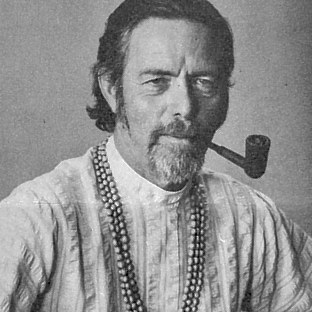
Seeing Beyond the Words: The Invitation of Alan Watts
Alan Watts invites us into a profound exploration of truth with his assertion, "Don't believe a word I say. See for yourself." This statement serves as a clarion call to engage directly with our own experience rather than relying solely on the authority of others. In a world saturated with information and opinions, Watts emphasizes the importance of personal inquiry and direct perception, urging us to cultivate our own understanding of reality. This approach not only democratizes wisdom but also empowers individuals to become active participants in their spiritual journeys.
Watts's words resonate deeply in a culture often fixated on external validation and dogma. By encouraging us to question and investigate rather than accept blindly, he challenges the conventional hierarchy of knowledge. This radical invitation to self-exploration is not merely a philosophical stance; it is a transformative practice that can lead to genuine insight and liberation. In essence, Watts beckons us to step beyond the confines of intellectual belief and into the expansive realm of lived experience, where true understanding resides.
The image / the metaphor
At first glance, Watts's quote may seem straightforward, yet it is rich with imagery and layered meanings. The phrase "Don't believe a word I say" evokes a sense of skepticism, urging us to question the very nature of authority and knowledge. The verb "see" is particularly striking; it implies an active engagement with the world, a call to open our eyes and perceive reality for ourselves. This invitation to direct observation suggests that wisdom is not something to be passively received but rather something to be actively discovered through our own experiences.
Diving deeper into the metaphor, we find that Watts is not dismissing the value of words or teachings; rather, he is highlighting their limitations. Words can point us toward truth, but they are not the truth itself. This distinction is crucial in Zen philosophy, where the ultimate reality often transcends verbal expression. By urging us to "see for yourself," Watts encourages a shift from intellectual understanding to experiential knowing, inviting us to engage with the world in a way that transcends mere belief.
In the speaker's tradition
Watts's teachings echo the sentiments found in classic Zen texts, such as the "Heart Sutra," which articulates the idea that form is emptiness and emptiness is form. This paradoxical statement invites practitioners to engage with the world without clinging to fixed notions or beliefs. By encouraging us to see for ourselves, Watts aligns with this Zen principle, urging us to cultivate a direct and unmediated relationship with reality, free from the constraints of preconceived notions.
Living the teaching
Consider a modern scenario where Watts's teaching might resonate: the overwhelming influx of information in our digital age. Many individuals find themselves bombarded with opinions, articles, and social media posts that shape their understanding of the world. In this context, Watts's invitation to "see for yourself" becomes a vital practice. Instead of passively absorbing information, one might choose to engage with their surroundings, seek out firsthand experiences, and cultivate a discerning eye that distinguishes between mere noise and genuine insight.
In the realm of relationships, this teaching can also be transformative. Imagine a situation where misunderstandings arise due to assumptions or preconceived notions about another person's intentions. By applying Watts's wisdom, one might approach the relationship with curiosity and openness, choosing to communicate directly and inquire about the other person's perspective rather than relying on assumptions. This practice not only fosters deeper connections but also cultivates a sense of empathy and understanding, allowing for a more authentic exchange between individuals.
A reflection
As we contemplate Watts's invitation to "see for yourself," we are prompted to reflect on our own relationship with belief and authority. In what areas of our lives do we find ourselves accepting ideas without question? What might it look like to engage more deeply with our experiences, to cultivate a sense of curiosity and openness? As you ponder these questions, consider how you might begin to embody this teaching in your daily life, allowing your own insights to guide your understanding of the world.




Join the BrightStar Community
Stay connected with daily inspiration, event announcements, and community wisdom