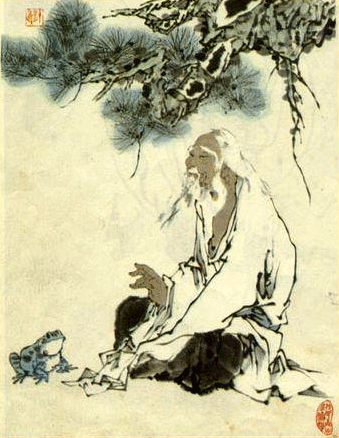
The Strength Beyond Conquest
Chuang Tzu's assertion that "He who conquers others has physical strength" invites us to reflect on the nature of true strength and the often superficial measures by which we gauge success. In a world that frequently equates power with dominance, this quote challenges us to reconsider what it means to be strong. It suggests that the ability to conquer others, while a demonstration of physical prowess, is ultimately a limited expression of strength that fails to capture the deeper, more profound qualities of resilience and wisdom.
As we delve into this teaching, we are prompted to explore the distinction between external victories and internal mastery. Chuang Tzu, a pivotal figure in Taoism, encourages us to look beyond mere physicality and to seek a more holistic understanding of strength. This perspective is especially relevant in our contemporary lives, where the pursuit of power often leads to conflict and disconnection. By examining the essence of strength through Chuang Tzu's lens, we can uncover a path toward a more meaningful existence, one that prioritizes inner peace over outward conquest.
The image / the metaphor
The imagery in Chuang Tzu's quote evokes a sense of physicality, emphasizing the raw power associated with conquering others. The verb "conquers" suggests a struggle, a contest of wills where one individual asserts dominance over another. This notion of strength is often celebrated in society, where physical prowess is equated with success and respect. However, the quote subtly implies that such strength is superficial, limited to the realm of the physical, and does not encompass the deeper dimensions of human experience.
Digging deeper into the metaphor, we can see that Chuang Tzu is inviting us to consider the nature of true strength, which lies not in the ability to overpower others but in the capacity for self-mastery and understanding. This deeper strength is characterized by qualities such as compassion, humility, and wisdom. In this light, the act of conquering becomes a metaphor for the struggle within oneself, where the greatest victories are those that lead to personal growth and enlightenment rather than domination over others.
In the speaker's tradition
Chuang Tzu's teachings are rooted in the rich tradition of Taoism, which emphasizes harmony, balance, and the interconnectedness of all things. Central to this philosophy is the concept of "wu wei," or effortless action, which encourages individuals to align with the natural flow of life rather than force their will upon it. This principle resonates with the idea that true strength is not about conquering others but about cultivating inner peace and understanding one's place within the larger tapestry of existence.
In the context of Chuang Tzu's work, we can draw parallels to the Buddhist concept of "sunyata," or emptiness, which teaches that the self is not a fixed entity but rather a dynamic interplay of relationships and experiences. Just as the Taoist sage seeks to transcend the ego-driven desire for conquest, the practitioner of Buddhism learns to let go of attachments and desires that lead to suffering. Both traditions invite us to explore the depths of our being and to recognize that true strength lies in the ability to navigate life's complexities with grace and wisdom.
Living the teaching
Consider a modern scenario where this teaching resonates: a workplace environment characterized by competition and ambition. In such a setting, individuals may strive to outdo one another, believing that success is measured by promotions and accolades. However, if we apply Chuang Tzu's wisdom, we might shift our focus from conquering colleagues to fostering collaboration and mutual support. By recognizing that true strength lies in uplifting one another, we create a more harmonious and productive atmosphere, ultimately leading to collective success.
Another application of this teaching can be found in personal relationships, particularly during conflicts. When faced with disagreements, the instinct may be to assert one's viewpoint forcefully, seeking to "win" the argument. Yet, by embodying Chuang Tzu's perspective, we can approach these moments with a spirit of understanding and empathy. Instead of striving to conquer the other person, we can cultivate a dialogue that honors both perspectives, allowing for growth and connection rather than division. This practice not only strengthens our relationships but also deepens our understanding of ourselves and others.
A reflection
As we contemplate Chuang Tzu's assertion, we are invited to reflect on the nature of our own strength. Are we measuring our worth by external achievements and victories over others, or are we seeking a deeper understanding of ourselves and our relationships? In what ways can we cultivate a strength that transcends physical conquest, embracing qualities such as compassion, wisdom, and humility? Consider this contemplative question: How might your life change if you prioritized inner mastery over external dominance?



Join the BrightStar Community
Stay connected with daily inspiration, event announcements, and community wisdom