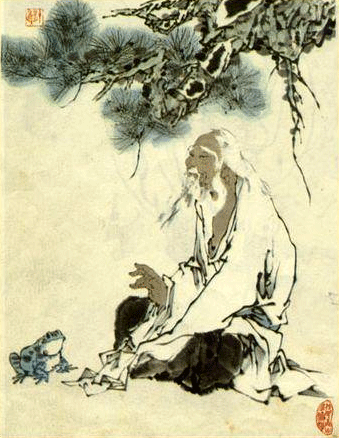
The Space Where Fortune Flourishes
Chuang Tzu's assertion that "Good fortune dwells where there is space" invites us to reconsider our relationship with abundance and opportunity. In a world often characterized by busyness and clutter, this quote serves as a gentle reminder that true prosperity arises not from accumulation but from the presence of openness and emptiness. The essence of this teaching lies in understanding that fortune, in its many forms, is more likely to manifest in environments that allow for freedom and potential rather than in those that are tightly constrained.
To delve deeper into this wisdom, we must recognize that "space" is not merely a physical absence but a profound state of being. It encompasses emotional, mental, and spiritual dimensions, suggesting that our capacity to receive good fortune is directly linked to our ability to create and maintain space within ourselves and our lives. This notion challenges the prevailing belief that success is a product of relentless striving, instead proposing that it is in the stillness and openness of our hearts and minds that we can truly welcome the gifts of the universe.
The image / the metaphor
At first glance, the imagery of "space" conjures thoughts of emptiness, a void waiting to be filled. However, Chuang Tzu's use of the word evokes a sense of potentiality, suggesting that this space is not merely a lack of something but a fertile ground for new possibilities. The verb "dwells" implies a sense of permanence and comfort, indicating that fortune is not a fleeting visitor but a resident in the homes we create within ourselves. This imagery invites us to visualize our lives as gardens, where the absence of clutter allows for growth and flourishing.
Diving deeper into the metaphor, we find that space embodies a paradox: it is both a relinquishing of control and an invitation to trust. In Taoist philosophy, this aligns with the concept of wu wei, or effortless action, where one allows life to unfold naturally rather than forcing outcomes. The space we cultivate becomes a sanctuary for intuition and creativity, enabling us to navigate life's uncertainties with grace. Thus, the metaphor of space transforms into a powerful symbol of receptivity, where fortune can find its way to us when we are willing to let go of our rigid expectations.
In the speaker's tradition
Chuang Tzu's teachings are deeply rooted in the Taoist tradition, which emphasizes harmony with the natural flow of life. Central to this philosophy is the concept of sunyata, or emptiness, which suggests that true understanding arises from recognizing the interdependence of all things. In this light, the idea of space becomes a spiritual practice, inviting us to embrace the void as a source of wisdom rather than a deficiency. The Taoist perspective encourages us to cultivate a sense of detachment from material possessions and rigid identities, allowing us to experience the fullness of existence in its most authentic form.
A relevant text that echoes this sentiment is the "Tao Te Ching," where Laozi speaks of the value of emptiness in the context of a vessel: "We mold clay into a pot, but it is the emptiness inside that makes it useful." This analogy reinforces Chuang Tzu's assertion, illustrating that it is the space within the pot that allows it to serve its purpose. By embracing emptiness, we open ourselves to the flow of life, enabling fortune to enter our lives in unexpected ways.
Living the teaching
Consider a modern scenario where this teaching resonates: a professional facing burnout from an overwhelming workload. In the pursuit of success, they may find themselves trapped in a cycle of constant activity, leaving little room for creativity or inspiration. By intentionally creating space—whether through setting boundaries, taking breaks, or engaging in mindfulness practices—they can cultivate an environment where new ideas and opportunities can flourish. This act of making space not only alleviates stress but also invites the possibility of good fortune to enter their professional life.
In the realm of relationships, the teaching of creating space can manifest in the way we communicate with loved ones. During moments of conflict, we often cling to our perspectives, striving to be heard and understood. However, by allowing space for vulnerability and openness, we create an atmosphere where genuine connection can thrive. This practice of listening and holding space for another's feelings fosters intimacy and understanding, ultimately enriching the relationship and inviting the fortune of deeper bonds.
A reflection
As we contemplate Chuang Tzu's wisdom, we are invited to reflect on our own lives: What areas are cluttered with expectations, fears, or distractions that may be blocking the flow of good fortune? In what ways can we create more space—physically, emotionally, or spiritually—to welcome new possibilities? This inquiry encourages us to embrace the art of letting go, allowing the natural rhythm of life to guide us toward the abundance that awaits in the openness of our hearts.




Join the BrightStar Community
Stay connected with daily inspiration, event announcements, and community wisdom