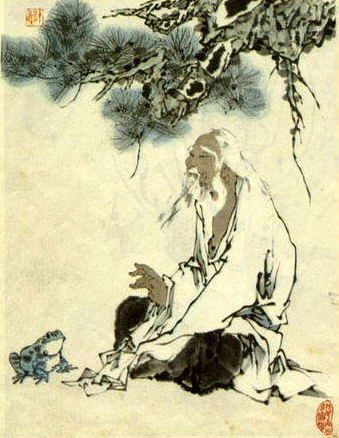
The Heart's Embrace: Cultivating Goodness in a Fragmented World
Chuang Tzu's assertion that "He whose heart is in the smallest degree set upon goodness will dislike no one" invites us to explore the profound connection between our inner disposition and our external relationships. This statement suggests that a heart inclined toward goodness fosters an expansive love that transcends personal grievances and judgments. In a world often marked by division and animosity, this teaching serves as a gentle reminder of the transformative power of compassion and understanding.
To delve deeper, we must consider the implications of goodness as a guiding principle in our lives. Chuang Tzu, a pivotal figure in Taoism, emphasizes the importance of aligning our hearts with the essence of goodness, which in turn shapes our perceptions and interactions with others. This alignment is not merely an ethical stance but a profound spiritual practice that can lead to a more harmonious existence, both within ourselves and in our relationships with others.
The image / the metaphor
The imagery in Chuang Tzu's quote evokes a sense of openness and warmth, suggesting that a heart attuned to goodness acts as a vessel for love and acceptance. The phrase "in the smallest degree set upon goodness" implies that even a slight inclination toward benevolence can have a significant impact on our attitudes toward others. The verbs chosen—"set upon"—convey a sense of intention and direction, highlighting that our hearts can be actively oriented toward goodness, shaping our experiences and interactions.
Delving deeper into the metaphor, we can see that Chuang Tzu is not merely advocating for a passive acceptance of others but rather an active engagement with the world through the lens of compassion. This perspective invites us to cultivate an inner landscape where love flourishes, allowing us to see beyond the surface of human flaws and conflicts. When our hearts are rooted in goodness, we become less inclined to harbor resentment or dislike, recognizing instead the shared humanity that connects us all.
In the speaker's tradition
Chuang Tzu's teachings are deeply embedded in the Taoist tradition, which emphasizes harmony with the Tao, or the fundamental nature of the universe. Central to this philosophy is the concept of wu wei, or effortless action, which encourages individuals to align their actions with the natural flow of life. In this context, goodness is not a rigid moral obligation but a spontaneous expression of our true nature, emerging when we are in harmony with ourselves and the world around us.
Moreover, the idea of goodness resonates with the Taoist understanding of interconnectedness, akin to the Buddhist concept of sunyata, or emptiness. Just as sunyata teaches that all phenomena are interdependent and devoid of inherent self, Chuang Tzu's assertion suggests that our capacity for love and acceptance arises from recognizing our shared existence. In this light, the practice of cultivating goodness becomes a means of transcending the illusion of separation, fostering a deeper connection with others.
Living the teaching
Consider a modern scenario where this teaching can be applied: a workplace filled with diverse personalities and competing agendas. In such an environment, it is easy to fall into the trap of judgment and dislike, particularly when faced with challenging colleagues. However, by consciously setting our hearts upon goodness, we can shift our perspective, choosing to see the strengths and struggles of others rather than their flaws. This approach not only enhances our own well-being but also contributes to a more collaborative and supportive atmosphere.
Another application of this teaching can be found in personal relationships, especially during moments of conflict. When disagreements arise, it is common to focus on the negative traits of the other person, leading to resentment and distance. By remembering Chuang Tzu's wisdom, we can consciously redirect our hearts toward goodness, seeking to understand the underlying motivations and emotions of our loved ones. This practice of empathy and compassion can transform our interactions, fostering deeper connections and healing old wounds.
A reflection
As we contemplate Chuang Tzu's profound insight, we are invited to reflect on the state of our own hearts. Are we, even in the smallest degree, set upon goodness? In what ways can we cultivate a more loving and accepting attitude toward those we find difficult to embrace? This inquiry not only challenges us to examine our biases but also opens the door to a more compassionate existence, both for ourselves and for those around us.




Join the BrightStar Community
Stay connected with daily inspiration, event announcements, and community wisdom