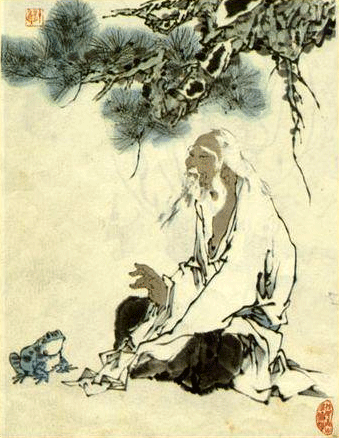
The Essence Beyond Words
Chuang Tzu's assertion that "words exist because of meaning; once you've gotten the meaning, you can forget the words" invites us to reflect on the profound relationship between language and understanding. This statement suggests that the essence of communication transcends the mere sounds and symbols we use. In a world often dominated by the superficiality of language, grasping the underlying meaning becomes essential for genuine connection and insight.
In a society where words are frequently wielded as tools of persuasion or division, Chuang Tzu's wisdom serves as a reminder of the deeper currents that flow beneath our verbal exchanges. The essence of communication lies not in the words themselves but in the meanings they convey. This perspective encourages us to seek clarity and depth in our interactions, fostering a more authentic engagement with ourselves and others.
The image / the metaphor
At first glance, Chuang Tzu's quote presents a straightforward relationship between words and meaning. The imagery evokes a sense of liberation; once we have grasped the essence of a concept, the specific language used to express it becomes secondary. The verbs "exist" and "forget" suggest a dynamic process where meaning is alive and evolving, while words are merely vessels that can be set aside once their purpose is fulfilled.
Diving deeper into the metaphor, we can see that Chuang Tzu is inviting us to consider the limitations of language. Words can be like nets cast into the ocean of understanding; they can capture moments of insight but may also obscure the vastness of the experience itself. By encouraging us to forget the words, he nudges us toward a more direct experience of reality, one that is unmediated by the constraints of language.
In the speaker's tradition
Chuang Tzu's philosophy is deeply rooted in the Taoist tradition, which emphasizes the importance of aligning oneself with the natural flow of the universe, or the Tao. Concepts such as "wu wei" (non-action) and "sunyata" (emptiness) resonate with the idea that true understanding transcends verbal expression. In Taoism, the essence of life is often found in the spaces between words, in the silence that allows for deeper insight and connection.
In the text of the Zhuangzi, Chuang Tzu often employs parables and anecdotes to illustrate the limitations of language and the importance of experiential wisdom. For instance, the story of the butterfly dream illustrates the fluidity of identity and reality, suggesting that our understanding is often clouded by rigid definitions. This aligns with the notion that once we grasp the meaning, we can let go of the words that attempt to capture it.
Living the teaching
Consider a modern scenario where this teaching might resonate: a heated discussion about a contentious issue. Participants may become so entrenched in their respective positions that the words they use become barriers rather than bridges. By focusing on the underlying meanings and emotions driving their perspectives, they can move beyond the words to find common ground, fostering understanding and compassion.
In a more personal context, think about a relationship where communication has become strained. Often, partners may argue over the specific words used rather than the feelings and intentions behind them. By embracing Chuang Tzu's teaching, they can prioritize understanding each other's emotional landscapes, allowing for a deeper connection that transcends the limitations of language. This shift can transform conflict into an opportunity for growth and intimacy.
A reflection
As we contemplate Chuang Tzu's wisdom, we might ask ourselves: What meanings lie beneath the words I use in my daily interactions? This question invites us to explore the essence of our communication, encouraging us to seek understanding beyond the surface. In doing so, we can cultivate a richer, more authentic engagement with the world around us.



Join the BrightStar Community
Stay connected with daily inspiration, event announcements, and community wisdom